Main Street may be about to get its own gigantic bailout. Rumors are running wild from Washington to Wall Street that the Obama administration is about to order government-controlled lenders Fannie Mae and Freddie Mac to forgive a portion of the mortgage debt of millions of Americans who owe more than what their homes are worth. An estimated 15 million U.S. mortgages – one in five – are underwater with negative equity of some $800 billion. Recall that on Christmas Eve 2009, the Treasury Department waived a $400 billion limit on financial assistance to Fannie and Freddie, pledging unlimited help. The actual vehicle for the bailout could be the Bush-era Home Affordable Refinance Program, or HARP, a sister program to Obama’s loan modification effort. HARP was just extended through June 30, 2011.
The move, if it happens, would be a stunning political and economic bombshell less than 100 days before a midterm election in which Democrats are currently expected to suffer massive, if not historic losses. The key date to watch is August 17 when the Treasury Department holds a much-hyped meeting on the future of Fannie and Freddie. A few key points:
1) Republican leaders believe this is going to happen since GOPers and Democratic moderates in the Senate are unwilling to spend more taxpayer money on more stimulus. But such a housing plan would allow the White House to sidestep congressional objections and show voters it is doing something tangible about an economy that seems to be weakening.
2) Wall Street banks are alerting their clients privately to this possibility. Here is what some are cautiously saying publicly. This from Goldman Sachs:
GSE policies are one of a dwindling number of policy levers the administration has left to pull, so it is conceivable that changes could be made, though there is no sign that a policy change is imminent. The Treasury’s essentially unlimited ability to provide financial support to the GSEs creates an interesting situation over the next twelve months: the GSEs could potentially be used to provide additional support for the housing market and, to a lesser extent, the broader economy in 2H 2001.
And this from Mizuho Securities:
As policy makers ponder their next move the data suggests that they face not only a stalling recovery but a growing risk of deflation taking root in the economy. As a result, the Administration has turned back to industrial policies by approving the purchase of a sub-prime auto lender by GM as a means for pumping up domestic sales, especially since the latest auto sales data indicates that consumers are still responsive to incentives. This precedent increases the risk that the government will use its control of Fannie and Freddie to increase consumer cash flow and juice the economy again.
Moreover, Morgan Stanley is pushing a mortgage relief plan directly to Congress. On August 3, a top Morgan Stanley economist recommended to the Senate Budget Committee that Fannie and Freddie ease their lending standards to allow millions of Americans to refinance their mortgages.
3) Keep in mind the political and economic context. The nascent recovery is already running out of steam. Wall Street economists just downgraded the government’s second-quarter GDP estimate of 2.4 percent to around 1.7 percent. And as even Treasury Secretary Timothy Geithner is warning, the unemployment rate may well begin to rise back toward the politically toxic 10 percent level given such sluggish growth. Many in the White House thought the unemployment rate would be dropping sharply by this point in the recovery.
But that is not happening. What is happening is that the president’s approval ratings are continuing to erode, as are Democratic election polls. Democrats are in real danger of losing the House and almost losing the Senate. The mortgage Hail Mary would be a last-gasp effort to prevent this from happening and to save the Obama agenda. The political calculation is that the number of grateful Americans would be greater than those offended that they — and their children and their grandchildren — would be paying for someone else’s mortgage woes.
4) And don’t think the White House is worried about financial market reaction. If they thought it would pass Congress, they would be submitting a $200 billion Stimulus 2.0 (3.0?, 4.0?) right now.
August is supposed to be a slow month for Washington politics. But maybe not this one.
Mortgage Miracles Happen

August 5, 2010

July 28, 2010
Zions Bank Unloads CDO Risk In Deal With Deutsche Bank
Zions Bancorp. (ZION) said late Wednesday that it unloaded risks from a $1.16 billion portfolio of collateralized debt obligations to Germany's Deutsche Bank AG (DB).
Shares of Zions climbed 2.5% to $21.78 in evening trading after the announcement.
Collateralized debt obligations, or CDOs, are complex vehicles that often contain asset-backed securities such as mortgage-backed securities.
Shares of Zions climbed 2.5% to $21.78 in evening trading after the announcement.
Collateralized debt obligations, or CDOs, are complex vehicles that often contain asset-backed securities such as mortgage-backed securities.
Is The Real Estate Market Turning Around?
From The Daily Capitalist
Interesting things have been happening in the real estate markets.
Residential
The home sales index spike from the home buyer tax credit has almost run out. If you didn't have a deal in escrow by April 30, you didn't get the credit. The time to close a deal was extended to September 30. The predictions were that we'd see a fall in July activity which is exactly what is occurring.
The reports that are currently coming in don't yet reflect July sales which will show a drop in sales. For example, the Case-Shiller report came in yesterday for May, 2010, but that report is a three-month average of prices. The report said prices were up 1.2% MoM, and 5.4% YoY. That was the peak of housing credit driven sales. According to S&Pwhich publishes the index:
"While May's report on its own looks somewhat positive, a broader look at home price levels over the past year" doesn't show that the housing market "is in any form of sustained recovery," said David M. Blitzer, chairman of S&P's index committee. "Since reaching its recent trough in April 2009, the housing market has really only stabilized at this lower level."
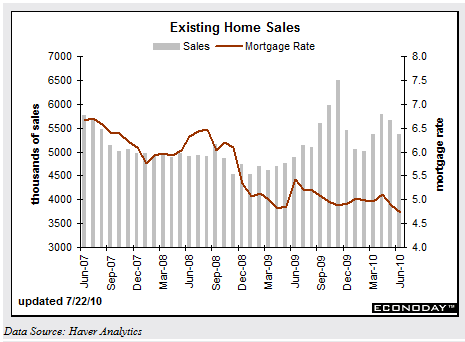
Last week the National Association of Realtors reported that June sales of existing homes declined 5.1% from May but up 9.8% YoY. Sales declined 9.3% in the west. Inventory rose in June:
The supply of homes available for sale in 27 major metropolitan areas at the end of June was up 3.7% from one month earlier, according to figures compiled by ZipRealty Inc., a real-estate brokerage firm based in Emeryville, Calif.
Ivy Zelman of Zelman Associates says for the past 27 years inventories have declined in June by 0.5%.
I showed this chart last week (click to enlarge):
Monday the FHA reported that the level of its insured mortgages more than 90 days overdue or in foreclosure jumped 35% YoY. But:
According to the FHA June single-family operations report, the total volume of mortgage in-force increased more than 24% to 6.4m in June compared to the same month one year ago. The total value of unpaid FHA mortgages was $865.5bn in June, up 30.3% from $663.8bn one year ago and up 3.3% from $837.8bn in May. ... But with that increase came a rise in serious delinquencies, 7.6% last year, compared to 8.3% in June. ...Based on applications received, the FHA said the seasonally adjusted annual rate of applications was nearly 1.9m, down 13% from the previous month's rate and the lowest since January's rate of 1.69m.
What this means is that most home loans are being financed with government guarantees from the FHA, Freddie (FMCC.OB) and Fannie (FNMA). I had thought the FHA had run out of money, but apparently their limits have been extended. The last numbers I saw said that 90% of loans are government backed.
According to Bloomberg yesterday, in an article about a surge in people renting apartments:
Finances for homeowners didn’t improve fast enough to prevent more than 1.65 million foreclosure filings in the first half, an increase of 8 percent from the same period in 2009, RealtyTrac Inc., a data company in Irvine, California, said July 15. A record 269,962 U.S. homes were seized from delinquent owners in the second quarter as lenders set a pace to claim more than 1 million properties by the end of 2010.
But here is probably the most significant statistic: home ownership rates have fallen to 66.9 from a high of 69.2% in 2004. In my Megatrendsarticle, I expected this to happen as home ownership rates revert to the statistical historic averages. This does not bode well for housing prices unless we see substantial increase in either population or inflation.
The sad fact is that the first time home buyer credit has substantially distorted the housing market and has hampered recovery. One could say that such meddling has set back recovery for nine months, or since last Fall when the tax credit began to artificially stimulate sales. Home prices will now stay under pressure as foreclosures continue to rise which will cause inventory to rise.
Commercial
Last week Fitch reported that defaults of commercial real estate backed mortgages (CMBS -- the CRE equivalent of residential mortgage backed securities) are increasing. They pointed to 8 properties held in CMBS portfolios are likely to default in August, each more than $20 million. They are interest only loans that were refinanced five years ago and now cannot get the financing to take out their existing lenders.
In August, Fitch expects 115 loans worth $1.3bn in balances to fall into special servicing and more to come through the rest of 2010, peaking in October at 181 loans at $2.1bn and totaling more than 772 loans worth $7.8bn. ...With more commercial mortgage-backed securities (CMBS) loans on the verge of default this Fall, special servicers are being forced to accelerate them through the REO process to avoid building a shadow inventory similar to the one in residential.
Also Deutsche Bank reported:
... that the number of new transfers into special servicing will continue to outpace commercial loan workouts. But once properties are ready for liquidation, valuations on commercial real estate are missing the mark, according to Deutsche Bank. ...The analysts projected an 18% delinquency rate on CMBS. Since the beginning of 2010, the balance of loans at least 90-days delinquent has increased every single month.“The implications for special servicers are potentially dire,” according to the Deutsche Bank report. “If they wait too long to foreclose or restructure loans, the number of loans in their portfolios will continue to build, so even when they finally resolve an asset it might not even make a dent.”
Based on my own anecdotal evidence and a review of earnings reports of regional and local banks, it appears that lenders are starting to deal with bad CRE loans rather than just "extend and pretend":
Many community and regional banks have aggressively charged off loans, mostly in commercial and construction financing. Despite signs of stability in delinquencies, banks still have to reappraise properties that serve as collateral. And when appraisals come in lower, the bank has to write it down, whether or not the loan is delinquent which in turn, hurts capital.
Wells Fargo (WFC) in its recent earnings release said:
Losses in the commercial portfolio continued to improve from the higher levels experienced last year, including a 10 percent linked quarter reduction in commercial real estate losses.
Reports from people I know who are active in CRE in the L.A. area also lead me to believe that lenders are starting to do deals on REO properties. While two years ago no deals were being made, today there is more opportunity and activity. Further there appears to be less "extend and pretend" as banks are less willing to accommodate defaulting borrowers; lending standards have tightened rather than loosened. They have about $500 billion in CRE loans maturing in the next couple years.
In my view, it is CRE that is critical to a recovery. We will need to see more positive signs, such as an increase in business loans, more CRE foreclosures, and a reduction in bank excess reserves, before we can say there is some kind of trend, but it could be that the CRE logjam is starting to break up. I do not expect any recovery of the CRE market any time soon because of the volume of debt maturing, but I am beginning to think that more defaults will be pushed into special servicing resulting in foreclosures. The result will be further downward pressure on CRE prices (they have already declined 24% since the peak in Fall 2007).
Credit Cards Transfer Money From Poor To Rich Households: Study
Credit cards do more than drain money from your wallet -- they may actually create an "implicit money transfer" from the poor to the rich, according to a new study from the Boston Federal Reserve.
The study, titled "Who Gains and Who Loses from Credit Card Payments? Theory and Calibrations", suggests that, as card use becomes more frequent, merchants have raised their prices to compensate for card-processing charges. (Hat tip to the WSJ)
As a result, the study suggests, the poor -- who usually lack access to reward-paying credit cards -- end up paying more for everyday goods.
Over the last two decades, the paper notes, the percentage of households using credit cards has remained stable at around 75 percent. But total card-spending has jumped from nine percent to 15 percent. The increased use of cards drives up fees paid by merchants, who raise prices to cover the costs of the cards.
As card-using households make more and more purchases with credit cards and jump to take advantage of card rewards programs, "cash-using" households bear the brunt of higher prices without any of the benefits of cards.
On average, each cash-using household pays $151 to card-using households and each card-using household receives $1,482 from cash users every year. Because credit card spending and rewards are positively correlated with household income, the payment instrument transfer also induces a regressive transfer from low-income to high-income households in general.
The authors suggest a few approaches policy makers could take to mitigate the damage caused by credit cards, including allowing merchants to adjust prices based on whether a purchase is made by cash or credit, a practice that is currently against the law.
Read More: Credit Card Fees, Credit Cards, Fed, Federal Reserve Bank Of Boston, Financial Overhaul,Income Inequality, Obama-Financial-Bill, Business News
September 4, 2009
Utah is offering more grants to buy houses. $8 million in housing grants
SALT LAKE CITY (AP) -- Utah Gov. Gary Herbert says he'll use $8 million in federal stimulus funds to help kick start the state's sluggish housing market.
Herbert's office released a statement Friday saying that the state will offer $4,000 grants to 2,000 home buyers.
The program comes on the heels of one started by former Gov. Jon Huntsman, who used $10 million in stimulus funds offer $6,000 grants.
The state awarded those 1,600 grants in less than 12 weeks earlier this year.
The Utah Housing Corporation says t
he grants have led to home sales of $376.7 million, creating thousands of jobs and millions of dollars in wages.
So if you are looking to buy a home this year, now is the time to get on the ball and take action.
If you don't you're missing out on free money.
Subscribe to:
Posts (Atom)